Design
There's not much to hate for a first-gen product, unless you're simply
not a fan of larger smartphones. That's because the One sports a
5.5-inch display and is 1.7mm taller and 0.6mm thicker than the
Samsung Galaxy Note 3.
It is, however, roughly four millimeters narrower and six grams lighter
than Samsung's 5.7-inch flagship. If you're not used to holding phones
bigger than a Galaxy S5 or Nexus 5, you may feel like you're stretching
hand muscles you never knew you had. I'm used to devices this size,
however, and I found that using the OnePlus One was as pleasant an
experience as you're going to get with any phone larger than 5.3 inches.
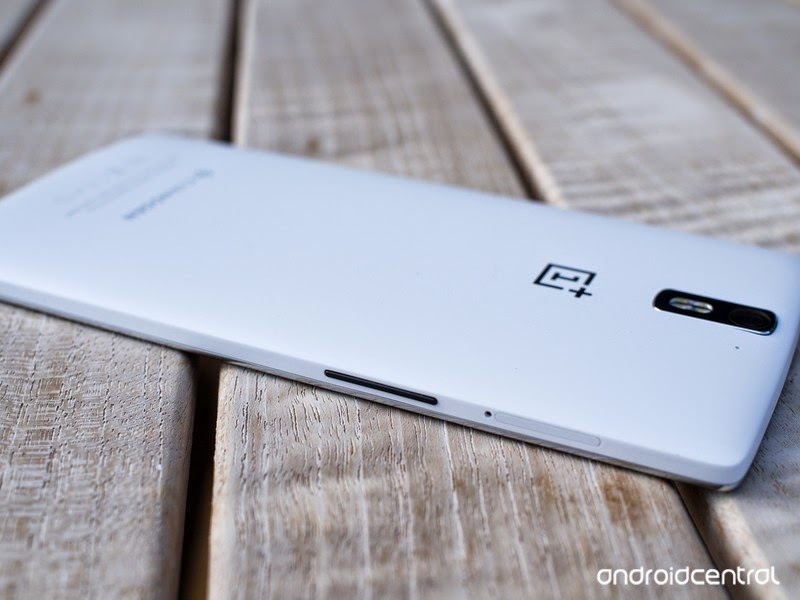
It features an arched back, which makes it rest more naturally in my
hands, and its blunt edges give my fingers plenty of room to rest
comfortably.
A volume rocker and micro-SIM slot line the left side of the One, while a
power button adorns the right. There's a 3.5mm headphone jack on top,
and you'll find twin speaker grilles flanking a micro-USB port on the
bottom. Some potential buyers might complain about the lack of a microSD
storage slot, but if that's really an issue, you can just spend an
extra $50 for the 64GB version. This is a fantastic deal compared to
other flagships that make you pay another $200 for that amount of space.
Display
Doing the calculations, the One's 5.5-inch 1080p IPS LCD panel has a
pixel density of 401 ppi. The pickiest of pickies will automatically
discount the quality of the screen based on the fact that it's not quite
as crisp as devices like the
HTC One M8
and Samsung Galaxy S5, but I'm sure you won't notice the difference.
And dare I say, I actually enjoy the One's display more than most
flagship smartphones, and it's leaps and bounds better than the Nexus 5.
Because it uses an IPS panel, the One's viewing angles are among the
best in the industry, keeping pace with the One M8 and absolutely
destroying the GS5. It's not quite as bright as the GS5, but it's still
respectable for a flagship-caliber device; heck, even its whites are
whiter than those three other phones. Most importantly, the colors are
natural, making them more satisfying to stare at than the saturated GS5
and overblown Nexus 5. In case this isn't your style, however, the
firmware lets you customize the amount of color saturation, intensity
and contrast.
Software
As if the One wasn't unique enough, it also comes with a much more
customizable Android experience than what 99 percent of users currently
enjoy. This is because OnePlus is an exclusive partner with
CyanogenMod, so naturally its very first phone comes with the firmware (build 11S, based on Android 4.4.2) directly baked in.
Camera
The OnePlus One offers a 13-megapixel rear camera with a Sony sensor, six-element lens setup and
f/2.0 aperture for lower-light shots. Additionally, the front-facing
camera tops out at 5MP -- a sizable improvement over the 1.3-megapixel
sensor on the N5.
The camera app is a special flavor made by the CyanogenMod team. It
consists of three circular buttons on the side for taking stills, video
and panoramic shots. Along the top sits some settings, scenes and a
toggle for the front-facing camera. In addition to HDR, night mode,
landscape and a few other standard options, the One has less-traditional
scenes like snow, sunset, party and theatre. These may offer some fun
ways to experiment with your camera, but I found that auto mode took
care of most scenarios perfectly well. But if you want to switch back
and forth, all you have to do is swipe your finger up or down on the
viewfinder.
When it comes to performance , the camera is great easy and quick and offers so great pictures with a great color production
Video recording here is solid, with up to 4K resolution and a bit rate
of 20 Mbps. You can also film in 60 fps slow motion at 1080p and 120 fps
at 720p. Since the One doesn't have optical image stabilization, CM had
to tweak the software to ease the pain a bit. It certainly helps,
because footage is noticeably smoother. It can't fully replace actual
hardware, of course, but the software enhancements at least make a
difference. The front mics seemed to pick up more sound than the rear
ones, so when taking movies of my children, my voice came out much
stronger unless they were close by; when filming them outdoors, however,
they sounded muffled when they were more than a few feet away.
Performance
It's hard to believe that a $300 device like the One has as much muscle underneath the hood as the Galaxy S5 and
Oppo Find 7. In fact, you technically can't get any faster, since the phone sports a 2.45GHz quad-core
Snapdragon 801 (MSM8974-AC), a 578MHz Adreno 330 GPU and 3GB of RAM
CyanogenMod's firmware gives you the option to change your performance
profile to one of three modes, ranging from power conservation to
battery sucker. If you don't want to use any presets, you can adjust
some of the settings manually, such as minimum and maximum CPU
frequency. This is definitely in advanced territory; I don't recommend
you try it unless you know what you're doing.
Over all the performance is really really fast with no lags what so ever ..
Battery

Battery life, at least, is a bright spot. The One has a 3,100mAh
non-removable cell that's just a tad smaller than the battery inside the
Note 3. What's more, it's actually larger than what you'll find in the
GS5 and One M8. On most days, I made it to the end of the evening with
around 5-10 percent life remaining. (On average, this constituted 14-15
hours of solid use, and roughly four hours of screen-on time.) These
were days full of emails, calls, travel, social networking and a little
bit of gaming. All told, our standard video rundown test yielded 10
hours of life. This isn't the best I've seen, but I'd consider it well
above average for a smartphone -- and I'm hard-pressed to ask for more
from a $300 device.
If You Liked This Post Please drop me a comment below telling me what you think of this full review :) ,, and please follow me for more :) thank you
!!
 Staying true to Sony's successful design language, the Xperia Z2's
exterior is mostly made of glass, with a nice metal frame adding
contrast and integrity to the body. It's not really exactly the same
design, though. While the contrasting, gray metal elements covered the
Xperia Z1's edges, in the Xperia Z2, the metal area is the central part
of the frame. This
Staying true to Sony's successful design language, the Xperia Z2's
exterior is mostly made of glass, with a nice metal frame adding
contrast and integrity to the body. It's not really exactly the same
design, though. While the contrasting, gray metal elements covered the
Xperia Z1's edges, in the Xperia Z2, the metal area is the central part
of the frame. This